PRD — Multi-Agent Orchestration

Conductor

A pair of self-contained Claude Code plugins: conductor-kernel supplies 19 domain-agnostic agents and 14 skills; conductor-dev adds 18 development agents and the /conduct command. Together they provide tiered quality gates, 5-signal classification, BRD-driven development, capability-based handoffs, intent engineering, hooks and schemas.

Install

Installs as a Claude Code plugin. The repositories are currently private, so marketplace add cannot resolve until they are published:

/plugin marketplace add bulletproofsoftware-ai/bulletproof-conductor-kernel
/plugin install conductor-kernel@conductor-kernel
/plugin list
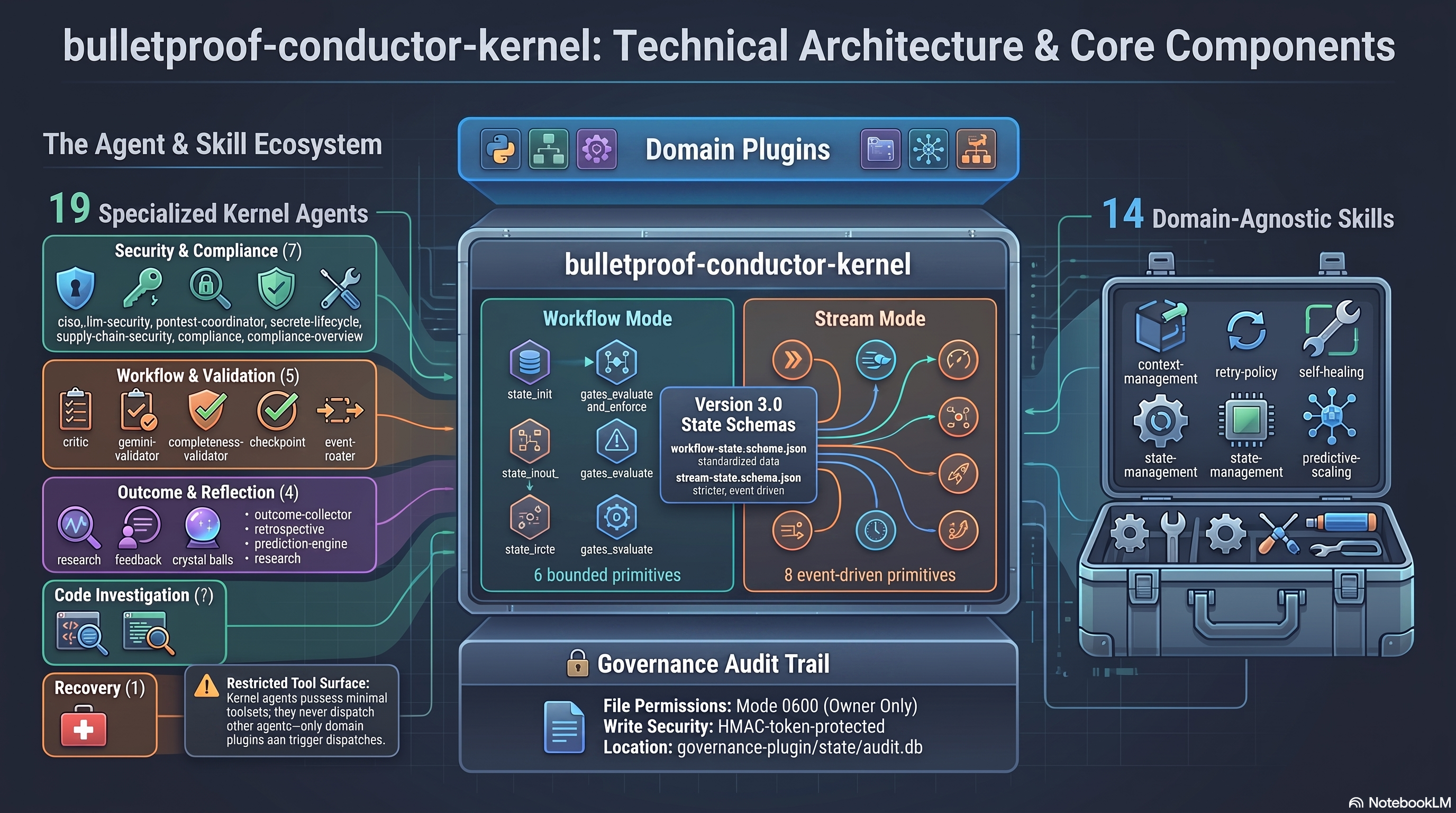
Conductor architecture infographic
Architecture infographic — from bulletproof-conductor-kernel/docs/media/
37
Bundled Agents
4
Quality Tiers
14
Kernel Skills
22
Requirements

1. Problem Statement

Complex software projects need more than a single AI agent. Individual agents optimize for their narrow scope while the overall system drifts — no shared state, no quality gates, no traceability back to requirements. You need orchestrated agents that enforce standards at every checkpoint.

But standalone agent files are fragile. They can be accidentally moved, archived, or broken by directory changes. There is no lifecycle management, no hook system, no bundled state tracking. A plugin solves this: agents, hooks, skills, schemas, and commands are packaged as a self-contained unit. Install the plugin, get the entire orchestration system.

No Orchestration

Single agent does everything. No quality gates, no traceability. Scope creep goes undetected. Security review is optional at best.

Standalone Agents

Separate .md files scattered in a directory. No hooks, no state persistence, no lifecycle management. Easily broken by file moves or archives.

Plugin-Based Orchestration

Self-contained unit. Hooks for lifecycle events. Built-in state tracking. Bundled skills and schemas. Single install = complete system.

2. Architecture Overview

4-Tier Quality Gates

TRIVIAL
Score 1.0–1.5 — typo, config change, single-file bugfix. One agent handles end-to-end. No CISO review, no architect handoff. Builder plans and implements in one pass; every critic gate is skipped.
MINOR
Score 1.6–2.3 — small enhancement, validation addition. Builder plans, then implements as a separate step. CISO and critic gates run in advisory mode: findings are logged but do not block progression.
STANDARD
Score 2.4–3.2 — new feature, multi-file change, API additions. Architect produces specs → CISO reviews → Builder implements → QA verifies. Most critic gates are advisory; pre-release and post-pentest gates block.
MAJOR
Score 3.3–4.0 — greenfield build, architectural change, new service. Full BRD-driven flow with adversarial review. Every critic gate blocks. Pentest coordination and supply-chain review run before release.

5-Signal Classification

Each signal is scored 1–4, then combined into a single weighted score that selects the tier.

Scope · 0.25

File count affected: 1 file = 1, 2–5 = 2, 6+ = 3, new repo = 4.

Type · 0.20

Typo/config/bugfix = 1, enhancement = 2, new feature = 3, greenfield = 4.

Risk · 0.20

Easily reversible = 1, reversible with effort = 2, hard to reverse = 3, irreversible = 4.

Ambiguity · 0.15

Crystal clear = 1, mostly clear = 2, needs discovery = 3, significant unknowns = 4.

Intent Sensitivity · 0.20

No intent overlap = 1, touches objectives = 2, touches trade-offs = 3, touches hard limits = 4. A score of 4 forces STANDARD tier or above.

Weighted score

(scope × 0.25) + (type × 0.20) + (risk × 0.20) + (ambiguity × 0.15) + (intent_sensitivity × 0.20) — the result maps directly onto the four tier bands above. The tier may be promoted mid-workflow as new information arrives, but never demoted automatically.

BRD-Driven Development

Every change traces back to a requirement

No code is written without a BRD ID. The state file conductor-state.json tracks the BRD ↔ spec ↔ implementation chain. QA closes the loop by verifying each BRD ID has a passing test. Drift between BRD and code is impossible to hide because the conductor's state file makes it visible.

3. Key Components

37 Bundled Agents

Split across the two plugins: conductor-kernel ships 19 domain-agnostic agents, conductor-dev ships 18 development agents. Names below are short forms; kernel files are <name>.md and dev files are conductor-<name>.md.

conductor-kernel — 19 agents

analyze-codebase bug-find checkpoint ciso completeness-validator compliance compliance-overview critic event-router gemini-validator llm-security outcome-collector pentest-coordinator prediction-engine recovery-engine research retrospective secrets-lifecycle supply-chain-security

conductor-dev — 18 agents

conductor agent-gateway api-design api-docs architect builder code-reviewer database devops doc-gen frontend-designer n8n observability performance project-setup qa qa-review refactor

14 Kernel Skills

All 14 ship in conductor-kernel; conductor-dev ships agents and the /conduct command, and inherits these skills from the kernel.

state-management

conductor-state.json lifecycle, validation, recovery from corruption.

brd-tracking

BRD ID extraction, spec linkage, gap analysis between requirements and implementation.

context-management

Context budget thresholds, spec-per-session limits, PreCompact coordination and handoff.

process-knowledge

SOP retrieval from Qdrant for non-deterministic procedures.

agent-interop

Capability-based handoff schema; agents declare what they need + what they produce.

agent-capabilities

The capability matrix the director consults to validate every agent assignment.

workflow-reference

Canonical per-tier workflow templates the director consults at every checkpoint.

sbr

Structured behavior reflection — agents reflect on outputs and revise before handoff.

retry-policy

Bounded retry and escalation rules applied when an agent dispatch fails.

self-healing

Failure classification and automated recovery playbooks.

event-automation

Event taxonomy and routing rules that connect workflow events to handlers.

outcome-measurement

Completion, rework and quality metrics collected across finished workflows.

predictive-scaling

Workload forecasting used to pre-select model tiers and resource budgets.

dashboard-integration

Surfaces live workflow state and metrics to external dashboards.

Intent Engineering

Capability-based handoffs replace named-agent calls. The director declares what capability it needs (e.g., "spec-decomposer", "security-reviewer"), not which agent. The plugin's manifest registry resolves the capability to a current implementation. This means agents can be replaced or renamed without breaking the director.

4. Requirements

REQ-COND-001 The plugin shall ship as a single self-contained directory bundling agents, hooks, skills, schemas, and commands; no external file dependencies required after install.
REQ-COND-002 A 4-tier quality gate system (TRIVIAL, MINOR, STANDARD, MAJOR) shall determine which agents and reviews run for any given task.
REQ-COND-003 Tier classification shall use 5 weighted signals: scope (0.25), type (0.20), risk (0.20), ambiguity (0.15), and intent sensitivity (0.20).
REQ-COND-004 Every code change shall trace to a BRD ID recorded in conductor-state.json; QA shall verify each BRD ID has a passing test before close.
REQ-COND-005 The director shall dispatch by capability, not by agent name; a manifest registry resolves capabilities to current agent implementations.
REQ-COND-006 Adversarial review (Gemini second-opinion) shall run at every checkpoint for STANDARD tier and above; results recorded in the state file.
REQ-COND-007 A critic agent shall block phase transitions on critical findings for MAJOR tier at every gate and for STANDARD tier at the pre-release and post-pentest gates; advisory for MINOR; skipped for TRIVIAL.
REQ-COND-008 CISO review shall be mandatory for any change crossing an authn/authz, secrets, or data-egress boundary.
REQ-COND-009 SessionStart hook shall detect conductor-state.json in CWD and surface active-workflow status as a system message.
REQ-COND-010 PostToolUse hook shall validate conductor-state.json against the bundled JSON schema on every Write/Edit and enforce phase-transition gates for STANDARD/MAJOR tier.
REQ-COND-011 The kernel plugin shall ship 14 skills: state-management, brd-tracking, context-management, process-knowledge, agent-interop, agent-capabilities, workflow-reference, sbr, retry-policy, self-healing, event-automation, outcome-measurement, predictive-scaling, dashboard-integration.
REQ-COND-012 A recovery-engine agent shall handle classified failures (transient, model, data, permission, logic, infrastructure, external) and apply playbook retries before escalating.
REQ-COND-013 Token budget tracking shall run after every agent dispatch; over-budget dispatches escalate to operator.
REQ-COND-014 The plugin shall expose the /conduct slash command for explicit workflow invocation.
REQ-COND-015 Pentest coordination shall run before release for STANDARD/MAJOR tier; findings tracked in state file until remediated.
REQ-COND-016 Doc generation shall run as part of every workflow for SDLC compliance evidence.
REQ-COND-017 Code Hardener scan-fix-rescan loop shall run before release for STANDARD tier and above.
REQ-COND-018 Code review shall use dual-AI adversarial review (Claude + Gemini) with consensus engine for STANDARD/MAJOR tier.
REQ-COND-019 Completeness validation shall run as the final gate before release; 12 check domains (8 static, 4 runtime).
REQ-COND-020 Process knowledge SOPs shall be retrievable from Qdrant via the process-knowledge skill.
REQ-COND-021 Builder readback verification shall confirm spec alignment before implementation begins.
REQ-COND-022 Git ratchet commits shall happen after every phase completion; PRs require all phase gates passed.
5. Prompt to Build It

Build a Claude Code multi-agent orchestration plugin:

1. PLUGIN STRUCTURE (two self-contained plugins — see §3):

   conductor-kernel (domain-agnostic):
   - agents/   (19 kernel agents)
   - skills/   (14 skills — state-management, brd-tracking,
              context-management, process-knowledge, agent-interop,
              agent-capabilities, workflow-reference, sbr, retry-policy,
              self-healing, event-automation, outcome-measurement,
              predictive-scaling, dashboard-integration)
   - hooks/    (SessionStart + PostToolUse with schema validation)
   - schemas/  (conductor-state.json schema)

   conductor-dev (development domain, built on the kernel):
   - agents/   (18 dev agents)
   - commands/ (/conduct slash command)
   - hooks/    (mirrors of the kernel hooks, own PLUGIN_ROOT)

2. 4-TIER QUALITY GATES (by weighted score):
   - TRIVIAL  : 1.0–1.5  typo, config, single-file bugfix
   - MINOR    : 1.6–2.3  small enhancement, validation addition
   - STANDARD : 2.4–3.2  new feature, multi-file change, API additions
   - MAJOR    : 3.3–4.0  greenfield, architectural change, new service

3. 5-SIGNAL CLASSIFICATION (scored 1–4, weighted):
   - scope              0.25
   - type               0.20
   - risk               0.20
   - ambiguity          0.15
   - intent sensitivity 0.20  (a 4 forces STANDARD or above)

4. BRD-DRIVEN: every change traces to a BRD ID. State file
   conductor-state.json tracks BRD ↔ spec ↔ impl ↔ test.

5. CAPABILITY-BASED HANDOFFS: director dispatches by capability,
   not by agent name. Manifest registry resolves capabilities.

6. HOOKS:
   - SessionStart  → detect conductor-state.json, surface status
   - PostToolUse (Write|Edit) → validate state file, enforce gates
                                (block phase transitions on STANDARD/MAJOR)

7. RECOVERY ENGINE: classify failures (transient/model/data/permission/
   logic/infrastructure/external) and apply playbook retries before escalating.

8. ADVERSARIAL REVIEW: Gemini second-opinion at every checkpoint for
   STANDARD+. Dual-AI code review with consensus engine.

9. INTEGRATION: writes trajectories + learnings + task outcomes
   to the memory system. Reads governance policy decisions.

6. Design Decisions

Plugin over scattered .md files

Bundling makes the orchestration system installable, versionable, and resistant to accidental file moves. The plugin manifest is the contract.

Capability-based handoffs over agent names

Names couple the director to specific implementations. Capabilities decouple — agents can be replaced, renamed, or upgraded without breaking the director.

4 tiers over a single workflow

A one-size-fits-all workflow is either too heavy for trivial changes or too light for major ones. Tiered gates match ceremony to risk.

BRD-driven over “just code it”

Every change traces back to a requirement. Drift between requirements and code is impossible to hide once the state file records the chain.

Critic blocks on MAJOR, advises on MINOR

Trivial changes shouldn't be blocked on every nit, so their gates are skipped entirely and MINOR gates only advise. MAJOR changes carry enough risk that every gate blocks; STANDARD blocks at the pre-release and post-pentest gates only.

Gemini second-opinion at every checkpoint

Single-model bias is real. Adversarial review with a different model surfaces issues a same-model reviewer would miss.

7. Hook Wiring

The conductor ecosystem is split across two installable plugins, each with its own hooks.json — both auto-discovered by Claude Code when installed under ~/.claude/plugins/local/. The hooks share the same script names but run from different CLAUDE_PLUGIN_ROOT values, so they execute independently and never race.

PluginEventMatcherScriptPurpose
conductor-devSessionStart*session-start.shDetect conductor-state.json in CWD, surface active-workflow status as a systemMessage. Silent if no state file present.
conductor-devPostToolUseWrite|Editpost-state-write.shWhen Write/Edit targets conductor-state.json: validate against bundled JSON schema AND enforce phase transition gates. Returns exit-code 1 to block illegal transitions for STANDARD/MAJOR tier workflows. Advisory (exit 0) for trivial-tier.
conductor-kernelSessionStart*session-start.shMirror of conductor-dev SessionStart for the kernel's own state surface. Different PLUGIN_ROOT, same script content.
conductor-kernelPostToolUseWrite|Editpost-state-write.shMirror of conductor-dev PostToolUse for the kernel's state schema and gates.

Why two near-identical plugins?

conductor-dev ships the developer-facing agents (architect, builder, qa, devops, etc.); conductor-kernel ships the system primitives (state management, event router, recovery engine, compliance, retrospective). They are deployed independently so the kernel can iterate without churning the dev pack. The hooks are duplicated because each plugin needs to know about its own state files and schemas.

8. Integration Points

→ Memory System

Conductor writes trajectories, learnings, and task outcomes to Qdrant via MCP tools. The director consults process-knowledge SOPs and heuristics at SessionStart. See the Memory System PRD.

→ Governance

The governance plugin's policy engine evaluates every conductor agent dispatch. Trust-mediated delegation enforces breadth/depth budgets. Audit events flow through the governance bus. See the Governance PRD.

→ Context-Guard

Context guard's 60% budget rule and max-3-specs constraint feed into the conductor's context-management skill. PreCompact telemetry tells the conductor when to defer follow-up work. See the Context-Guard PRD.

→ Plugin ecosystem

Conductor is the canonical example of the plugin architecture: agents + skills + hooks + schemas + commands packaged as a single installable unit, deployed under ~/.claude/plugins/local/.